
In the enlarged Belarus there are 70.4% Belarusians, 16.7% Great Russians, 9.7% Jews, 2.2% Poles and 1% of other nationalities.
Education. In the Minsk region alone there are 76 seven-year schools. Of these, 34 are Belarusian-Russian (mixed), 28 are Russian, where the Belarusian language is taught as a compulsory subject, 9 are Belarusian, where the Russian language is compulsory as a subject, 4 are Jewish and 1 is Polish. There are 1423 incomplete seven-year schools and elementary schools, of which 1281 are Belarusian, where the Russian language is taught as a subject only from the third year of study, 57 are Polish (this is in the Minsk region alone—Ed.) and 47 are Jewish.
In the seven-year schools, incomplete seven-year schools and elementary schools (primitives) there are 129885 pupils, of whom 110262 are Belarusians, 11883 Jews, 3345 Poles, 4400 Russians and 45 of other nationalities.
Teaching staff: of 3309 teachers, 2584 are Belarusians, 333 Jews, 107 Poles and 285 Russians.
The picture is approximately the same in the children's homes and kindergartens.
Belarusian State University. The Belarusian State University, opened in Minsk in 1921, has faculties of medicine, social sciences and pedagogy, and a morning and an evening workers' faculty. It has more than 4000 students and 214 professors and their deputies.
Soviet Belarus has 2 agricultural institutes (Minsk and Horki) with 1400 students, a special pedagogical institute in Vitebsk, 2 workers' faculties (morning and evening) in Orsha and 1 workers' faculty in Horki, and 13 pedagogical technical schools (seminaries), of which 4 are Belarusian, 6 Russian, 2 Jewish and 1 Polish. It also has 3 industrial technical schools, 6 agricultural technical schools, 5 medical technical schools, 2 forestry schools, 2 industrial-economic schools and 4 music and art schools. Besides these there are 24 vocational-technical schools with 2000 pupils, 4 agricultural schools with 300 pupils, 7 demonstration and applied workshops with 365 pupils and 13 various courses with 2120 pupils.
The total number of students in the higher schools of the Soviet Belarusian Republic is 6500.
In Minsk there is an Institute of Belarusian Culture, as the beginning of a Belarusian Academy of Sciences.
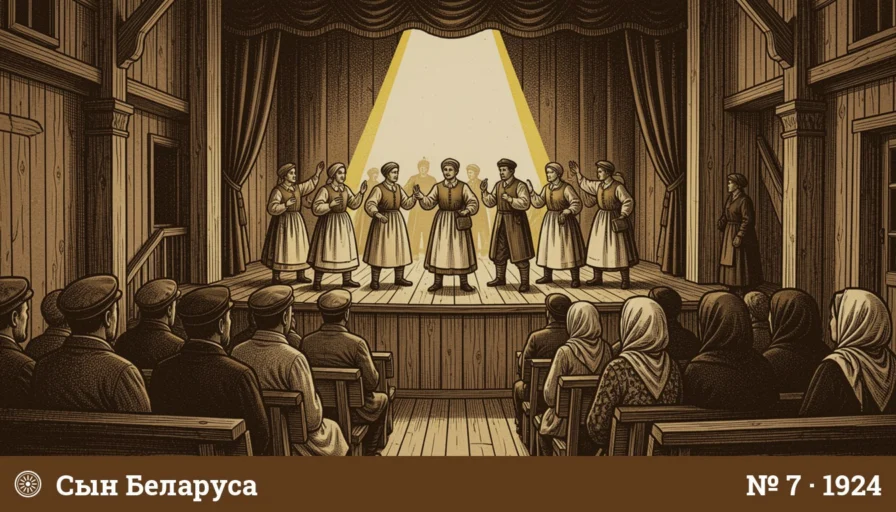
Theatre. The Belarusian State Theatre in Minsk, which came into being 3 years ago, has made great progress over the last year. The theatre stages a number of Belarusian plays and translated ones (Molière and others). Now the theatre, on the instruction of the Belarusian Government, is touring the cities recently joined to the Belarusian Republic, Vitebsk, Mogilev and others, and is acquainting the population with the achievements of the Belarusian national theatre. These achievements in so short a time are enormous: careful staging, solid and beautiful performance, a harmonious union of drama, ballet and song, all this makes the theatre interesting. The performance of Belarusian national songs is especially interesting in the theatre.
The diligence and interest of the Government of the B.S.S.R. in matters of Public Education in the Belarusian Republic can best be illustrated by figures: in the budget of the Belarusian Socialist Soviet Republic, Public Education takes 30.4 percent.
Because of the decline of Belarus in pre-revolutionary times, all the work of the state organs of the Republic and of the party organs now goes along the line of popular education, to the struggle against illiteracy and to its elimination.
Newspapers. Newspapers are published in all four languages used in the B.S.S.R.: 3 in the Belarusian language (one of them for youth), 2 in Russian (one for youth), 2 in Yiddish (one for youth) and 2 in Polish (one for youth). Besides these, 3 journals are published, of which 2 are in the Belarusian language and 1 in Russian („Народное Хозяйство Белоруссии“). Over the last year the circulation of newspapers has grown by 50%. In April of this year 231000 copies of newspapers a week were issued across the territory of Soviet Belarus. Workers' and peasants' correspondents and others who write regularly for the newspapers number up to 2000 persons in Soviet Belarus.
The Belarusian publishing house „Савецкая Беларусь“ publishes books exclusively in the Belarusian language. The overwhelming majority of them are Belarusian textbooks, for which the population shows a great demand.
Comments
To leave a comment, sign in with Telegram
Scan QR or open Telegram:
Open in TelegramWaiting for confirmation…