
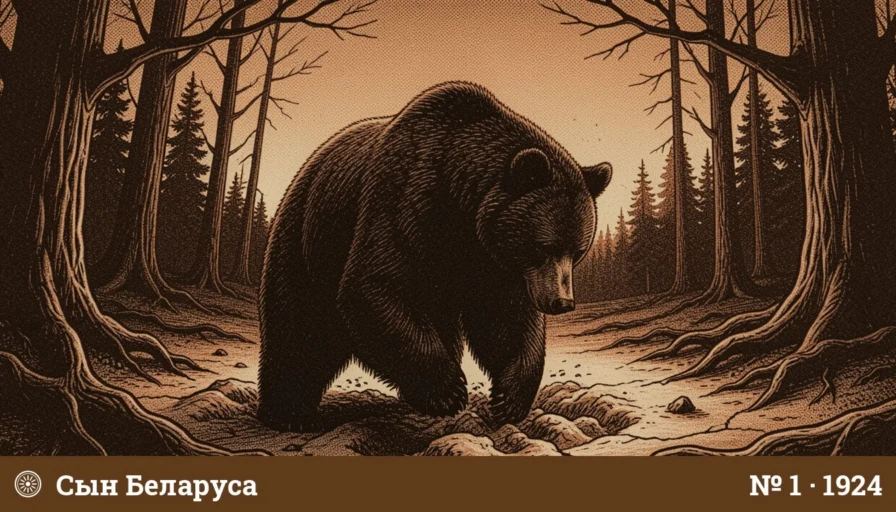
Once upon a time there lived a bear and a she-bear. They lived in a great forest. A son was born to them, little Mikitka. The bear cub was nimble, healthy and merry. Mikitka grew and grew, bigger and healthier with each day. And so he grew into a big bear, Mikita. His parents could not take enough joy in him: he was so fine and handsome, just blood and milk. But it became too much for the parents to feed him, and so the old bear said: "Listen, son! You are a big Mikitka now, and we are old. You have great strength, and you roar louder than I do: you can earn your own living. Go and seek your own bread."
What was to be done? Mikita set out from his old parents. His father measured out for him a piece of forest, a patch of apiary, a loft of reeds and a strip of brushwood. Taken all together, you could not have walked around it in three months. Mikita walks about his Fatherland, looking around, and suddenly, plop! he falls into a wolf pit.
The wolves leapt around him, howled and barked: they invited him to be their guest. They entertained him for a long time, fed him well, laid him down to sleep in a soft bed. Somehow it came about that the bear settled in there altogether and stayed: it was good and peaceful for him. But as day followed day, Mikita was given more work and less food. Mikita amuses the wolf cubs, Mikita keeps watch by night, Mikita makes the bed and tidies it for the wolf, goes out hunting. And still he cannot please them; however hard he tries, it is never right. At night the poor fellow would sometimes weep or groan. Then the she-wolf turned savage at him too: "You," she says, "don't let us sleep at night." The bear cursed his lot. But what was worse than the worst was that the wolves forbade Mikita to roar in a bear's way: they told him to howl in a wolf's way. However hard he tried, he could not manage it: his voice was too coarse, and he could not draw out the wolf's note. He would sometimes break into a sweat, his throat aching from trying so hard to make it thin, and even so the wolves grew angry and laughed. Once the wolves held a wedding. They told Mikita to sing and dance, and laughed at him themselves, teasing him. The next day the bear caught a calf, brought it to the pit and gave it to the wolves. The she-wolf grumbled that what he had caught was lean. Well, the wolves feast, revel and make merry, while to Mikita they gave only a bare hide to gnaw. A sort of grief gripped Mikita by the throat and he was already ready to put an end to himself.
Then one day Mikita is dozing by the pit, while the old she-wolf is teaching her cub how to live in the world. She did not notice Mikita. And Mikita hears the she-wolf say to her child: "…fear no one! Be bold and cunning, and then everyone will fear you. Here we have a bear in our service. He is strong; he could beat us all, but we outwitted him, because he is a fool, Mikita."
Mikita's heart began to pound; the blood rushed to his head. "So that is how it is? thinks Mikita: they ought to serve me, not I them. Well, I have suffered enough through my foolish wits!"
Mikita sprang up and struck the wolf cub on the head with his fist, and it kicked up its little paws. The she-wolf went for Mikita, and he slapped her across the muzzle with his paw so that her teeth went flying. The she-wolf let out a mute howl; from somewhere a whole pack of wolves appeared and went for the bear. And he tore up a fir tree by the roots and swung it once — he laid half of them low; swung it a second time, and not one was left. Then the wolves' kinsfolk came running up: jackals, werewolves, hyenas. Mikita twisted off their heads as well.
Then Mikita roared in a pure bear's voice, so resoundingly that the echo carried that voice farther and farther, to the very edge of the forest. The mountains trembled, the old oaks shook, all the beasts in the forest took fright. Then everyone knew that Mikita had become the free master in his Fatherland.
("Krynica" No. 6).
Comments
To leave a comment, sign in with Telegram
Scan QR or open Telegram:
Open in TelegramWaiting for confirmation…