
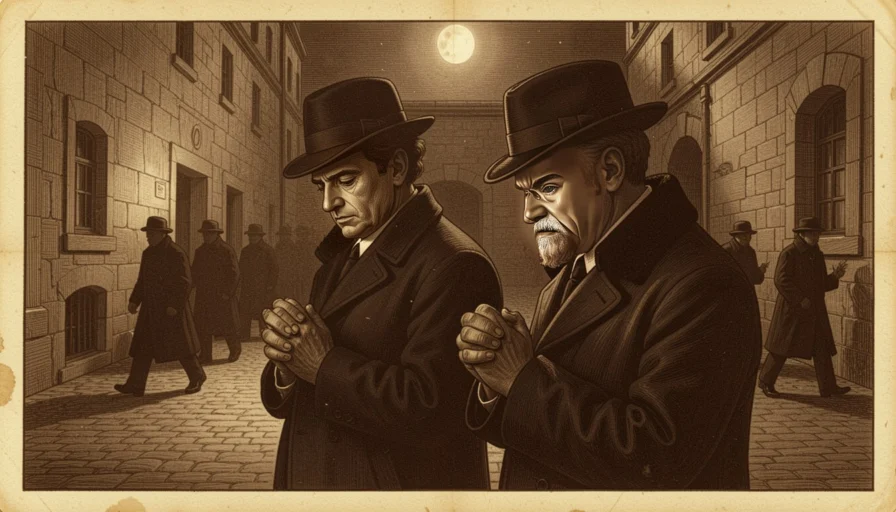
89 years ago, on the night of 29 to 30 October 1937, more than 130 representatives of the Belarusian intelligentsia were shot in Minsk: writers, poets, scholars, and state and cultural figures.
NKVD officers shot the people in the inner courtyard of the prison known as the "Amerikanka". According to other accounts, more than 100 members of the national elite were shot.
That night entered memory as the "Night of the Executed Poets".
Among those shot were 22 men of letters. Accounts published in non-state Belarusian media describe the shootings in Minsk as the work of the NKVD.
Non-state Belarusian media call these shootings a deliberate attempt to destroy the Belarusian intelligentsia, culture and national identity. In their assessment, the tragedy became a symbol of the destruction of Belarusian culture and the national elite by the Soviet authorities.
One outlet offers an even harsher assessment: in its words, the NKVD wanted to kill the "soul of Belarus".
Every year in these days, commemorations are held under the shared name "Night of the Executed Poets".
In 2023–2024, events took place in Berlin, Vilnius and Paris, tied to the memory of the 132 people shot on 29–30 October 1937.
In Vilnius, on 29 October 2023, a rally and poetry reading were held on Vincas Kudirka Square, along with the lighting of 132 candles on Town Hall Square. The same day in Berlin, a concert and accompanying programmes were held in memory of the killed Belarusian poets and in support of contemporary Belarusian literature.
Another resolution that non-state Belarusian media write about obliged the Presidium of the Academy of Sciences of the BSSR to organise a comprehensive study of the causes and consequences of the mass repressions of the 1930s–1940s and early 1950s in Belarus. The Belarusian Soviet Encyclopedia publishing house was instructed to prepare a special edition in memory of the victims of the repressions of those years.
By various estimates, tens of thousands of people may have been killed in the 1920s–1950s at mass execution sites near Minsk, including Kurapaty.
The Kurapaty tract is called a "non-healing wound on the body of Belarus": it holds victims killed in the 1930s. The Soviet administration concealed the crime, but the truth became known to the public, including thanks to the article by Zianon Pazniak and Yauhen Shmyhalyou, "Kurapaty — the Road of Death".
Comments
To leave a comment, sign in with Telegram
Scan QR or open Telegram:
Open in TelegramWaiting for confirmation…