
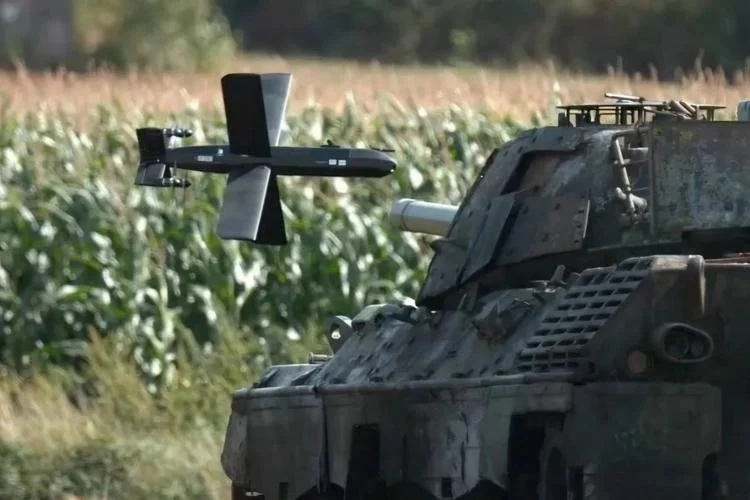
On Sunday, 22 November, the German army carried out its first tactical tests of kamikaze drones in Lithuania. They took place at the Rudninkai training ground, not far from the border with Belarus.
Drones made by the German companies Helsing and Stark, carrying no explosives, were directed at battle tanks and crashed into them. The warheads used in the tests were training ones. According to Reuters, the tests were observed in person by the commander of the German Army, Lieutenant General Christian Freuding.[1]
A few days earlier, at the same training ground, the military tested Clarity for the first time, an artificial intelligence programme from Helsing. It analyses large volumes of data from satellites, drones and sensors and proposes courses of action.
Freuding, who previously oversaw German weapons deliveries to Kyiv and is due to become head of Germany's armed forces in February, called both types of systems indispensable for modern warfare.
The tests are taking place as part of Freedom Shield, the German army's largest exercises in Lithuania to date. The Freedom Shield 26-II and Grand Eagle 26 manoeuvres run until 3 December 2026 and involve more than 6000 service members. Units from Germany, the Netherlands, Norway, the Czech Republic, Croatia, Belgium and Luxembourg are taking part, as well as Lithuanian troops.
According to LRT, citing the press service of Lithuania's Defence Ministry, the exercises involve units of the 45th Armoured Brigade "Lietuva" and the 37th Mechanised Infantry Brigade "Saxony" of Germany's 10th Panzer Division.
Such drones can loiter over a designated area, then dive at high speed onto a target and explode on impact. Both Russia and Ukraine use them in the war.
Germany decided to buy such weapons only in 2025, after years of debate, and for it these tests are a significant step.
Comments
To leave a comment, sign in with Telegram
Scan QR or open Telegram:
Open in TelegramWaiting for confirmation…