
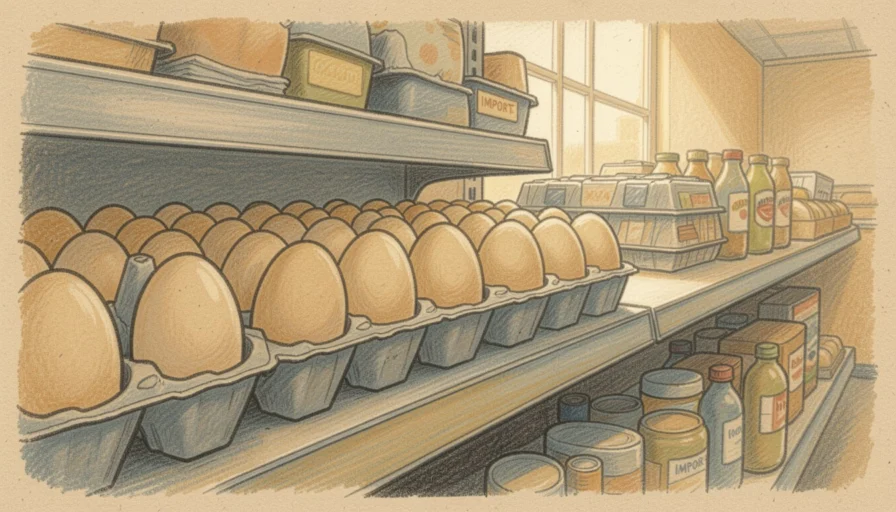
In the first nine months of 2026, the largest share of imports in Belarusian shop sales was in vegetable oil, fruit and fish, while Belarusian producers lead in sales of eggs, meat and vegetables. This is according to Belstat data cited by private Belarusian publications working in the country. By the same data, the picture by product group was very similar after the first half of the year.
First: fresh fruit and nuts. From the start of the year to the end of September, the share of imports in their sales was 88.3%, the highest among the product groups named.
Second: fish. The share of imports here was 85.1%.
Third: vegetable oil. Imports accounted for 84.9% of sales.
Fourth: cereals. Imported ones accounted for 59.5% of sales.
Fifth: apples. Imported ones accounted for more than 55% of sales.
Sixth: pasta. Imported ones accounted for 43.3% of sales.
Seventh: chocolate and confectionery containing cocoa. The share of imports was 41.6%.
Eighth: baby food. The share of imported products was almost 33%. Across the ten groups named in the data, the share of imports ranges from 33% to 88.3%, a spread of 55.3 percentage points.
Ninth: eggs. The share of Belarusian goods in their sales over the nine months was 100%.
Tenth: butter, rapeseed oil and vodka. In these categories, Belarusian products account for more than 99%.
Eleventh: meat and canned meat. In most segments, the share of domestic goods is between 90% and 99%. Over a rolling year, Belarusians bought about 19% more canned meat.
Twelfth: alcoholic liqueurs. Over a rolling year, 17.1% more of them were bought.
A Russian survey on goods from EAEU countries, cited by the Russian outlet rg.ru, shows how Belarusian products look on the neighbouring market. 71% of participants bought Belarusian-made goods over the past year. Products from Armenia were bought by 35% of respondents, from Kazakhstan by 19%, from Kyrgyzstan by 11%; the spread between these countries is 24 percentage points.
Products from EAEU countries are bought once a week or once every two weeks by 37% of Russians, and once a month by 23%; the difference is 14 percentage points. Another 12% said they had bought such goods only a few times in their lives, and 8% said never. The difference between these groups is 4 percentage points. 19% of respondents rarely look at the country of origin.
According to the survey, products from EAEU countries are in demand in Russia, but the demand is unevenly distributed. Linda Ryzhikh, whom the outlet cites, said: “Many industrial goods from EAEU countries remain in the shadows: their brands are little known to the Russian consumer, and producers' marketing budgets are incomparable to the resources of Russian and international competitors.”
In the other direction, she said, the highest demand in EAEU countries is for Russian highly processed products: confectionery, baby food, vegetable oils, household chemicals, cosmetics and perfumes. She also described demand for Russian tyres, pharmaceutical products and motor fuel as fairly high. Some of these groups — confectionery, baby food, vegetable oil — coincide with those where the share of imports in Belarusian shops is large.
Retail turnover in Belarus in the first quarter of 2026, according to Belstat, was 25.6 billion rubles, or 106% in comparable prices of the level of the first quarter of 2025. In February 2026, preliminary data from Belstat and the Ministry of Antimonopoly Regulation and Trade reported that total retail sales in January had grown year on year in comparable prices.
According to the World Bank, inflation in Belarus in 2025 was 6.6% and GDP growth was 1.3%. The IMF forecasts GDP growth of 1.9% and inflation of 5.1% for 2026.
Comments
To leave a comment, sign in with Telegram
Scan QR or open Telegram:
Open in TelegramWaiting for confirmation…