
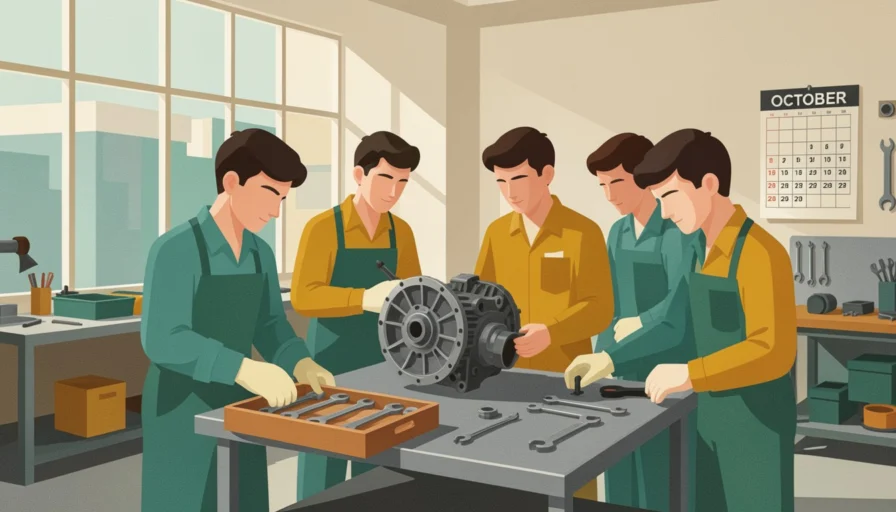
Electric cars in Belarus stopped being an exotic novelty some time ago, and as their popularity has grown, so has the need for specialists who can service and repair them. Educational institutions are responding to this demand: colleges and universities are opening new programmes and adding specialised subjects.
The scale of the market is described by these figures. As of 1 October 2026, there were more than 73,000 "green" cars in the country, of which over 29,000 were registered in the first nine months of this year. Siarhei Khudoyeshko linked this trend, among other things, to government incentives, which, in his words, made electric transport affordable. This is the assessment of the side that introduced those measures itself.
Every month this year, 3,000 to 4,000 cars are sold in Belarus. The share of electric cars in the country is 14.7%, while in Russia, according to the same data, it is only 0.2%. According to Khudoyeshko, the infrastructure includes more than 2,600 publicly accessible charging stations, of which more than 2,000 are fast chargers. More 120 kW stations have also appeared. On 7 October 2026, Council of Ministers Resolution No. 505 was issued, aimed at gradually increasing the use of electricity in suburban passenger transport.
A batch of Dongfeng BOX MY2027 electric cars, which are reportedly adapted to harsh Belarusian winters, has been delivered to the country.
Training at colleges is strictly divided into theory and practice and takes about a year on average. After that, students consolidate their skills at Belarusian enterprises and enter the market as ready specialists. Such programmes also interest foreigners: according to private Belarusian outlets operating in the country, specialists from CIS countries, where electric-car production is actively developing, are seeking to improve their qualifications. According to the same reports, the education systems of colleagues abroad are not yet keeping up with demand.
For electric-car owners, something else matters more: who will repair the car, and how quickly. According to private Belarusian outlets operating in the country, some workshops already take on even complex and specialised repairs, but some parts have to be searched for and waited on for months. Gradually, parts for Chinese cars are also appearing at scrapyards.
Uladzimir Kazhanouski said that a part from China takes, on average, from one and a half to two months from the moment of ordering, and sometimes the wait stretches to six months. Even if a part is available, say, in Moscow and could be brought in a day, delays at the border mean delivery sometimes takes months, he said. So if a workshop knows that a needed part is available from suppliers and may soon be required, it tries to buy it in advance. It is not yet known what measures could shorten delivery times.
With mechanical parts, according to Kazhanouski, there are usually no particular difficulties. For popular BYD, Geely, Li Auto, Voyah, Zeekr models and other makes common in Belarus, brake pads, brake discs, suspension arms and other parts are almost always available. The hardest things to find are electronics: control units, inverters, electric motors, driver-assistance cameras and sensors. On some European cars a unit can be adapted or coded, but with Chinese cars that option is not always available, and quite often exactly the matching unit is needed.
Problems, in his words, arise mainly with rare models. A NIO ES8 is currently in the workshop: they searched for brake pads for about a month and are now waiting for delivery. A person buys a rare car because they like the model and does not always think about servicing in advance. Still, there are also those who find out before buying how available parts are and where the car can be serviced.
Valery Kirylenka said that in the field of "organisation of technical servicing of vehicles", students study automotive electronics and the design of electric cars. Upon completion they receive four working trades: car repair fitter, driver, tyre fitter and grade 5 auto mechanic. For the specialty "maintenance of electronic systems of vehicles", the passing score among targeted-place applicants this year was 8.5.
Danila Shevko explained that in practical classes future mechanics work with special equipment that delivers 750 V. This is needed to activate and safely test high-voltage components right on workbenches rather than inside a car. According to him, the college provides a foundation that lets graduates work with electric cars of any global brand, from Geely and BYD to Voyah, Lixiang, Zeekr and Dongfeng. This is the assessment of the educational institution itself. It does not change the delivery times for electronic components that Kazhanouski talks about.
Training mechanics for electric transport has been under way in the country for more than a year. In June 2025, Belarus began accepting applications for five new specialties, including car body repair. In July 2026 it became known that the Minsk State Automechanical College named after Academician M. S. Vysotski had started, from the new academic year, to train specialists in the repair and servicing of electric transport.
Comments
To leave a comment, sign in with Telegram
Scan QR or open Telegram:
Open in TelegramWaiting for confirmation…