
Lithuanian Foreign Minister Kęstutis Budrys on 5 November denied, in an interview with the radio station Žinių radijus, reports of US pressure on Vilnius to resume Belarusian potash transit. "I can state with full responsibility that nothing of the kind is happening at present (…), it absolutely does not correspond to reality," he said, commenting on a Politico publication.
US administration representatives told The Kyiv Independent they were dissatisfied that the Trump administration's foreign policy initiatives compete with one another and are poorly coordinated.
Politico reported on 29 October that Cole had discussed with Lithuanian diplomats the possibility of resuming potash shipments through the port of Klaipėda.
According to the Kyiv Independent, the attempts to open Lithuania's ports to Belarusian potash are an initiative of Trump's special envoy for Belarus, Cole, not of the White House, and they have no broad support in Washington. American officials, the outlet writes, say that Cole is pursuing an independent initiative, not a coordinated state policy. In the US president's administration it finds almost no support, the outlet claims.
One of the outlet's interlocutors said that career State Department diplomats are often unaware of initiatives that Cole and Steve Witkoff promote on their own.
A European official familiar with Vilnius's position told the outlet that the US State Department has never raised the issue of resuming Belarusian fertiliser transit with Lithuania, and that the initiative comes solely from Cole.
Budrys said on LRT that fertiliser transit is a matter of EU sanctions and Lithuanian national measures, and is not on the list of topics for discussion with the US. "We did not talk about this… This is our business" (translation). According to him, sanctions against Minsk were discussed with the American envoy, and fertilisers were not touched upon. Ignas Dobrovolskis, an adviser to the Lithuanian prime minister, said earlier that Lithuania is not negotiating on transit.
However, a quote from Budrys that is cited in reference to a meeting sounds different: "Until today, both publicly and to you, I have repeated that there is no pressure on us from the Americans and no questions related to fertilisers — how these sanctions are imposed and the like. Today I can say that pressure is emerging" (translation). According to BNS sources, the minister said at the meeting that pressure is being applied not only to Lithuania but also to other countries in the region. Budrys said earlier that a return to transit is possible only by lawful means, and that Vilnius seeks to minimise the impact on business without weakening its sanctions policy.
It was initially reported that this was an official approach by special envoy Cole, but that information is not accurate: it concerns an informal approach sent by the US State Department.
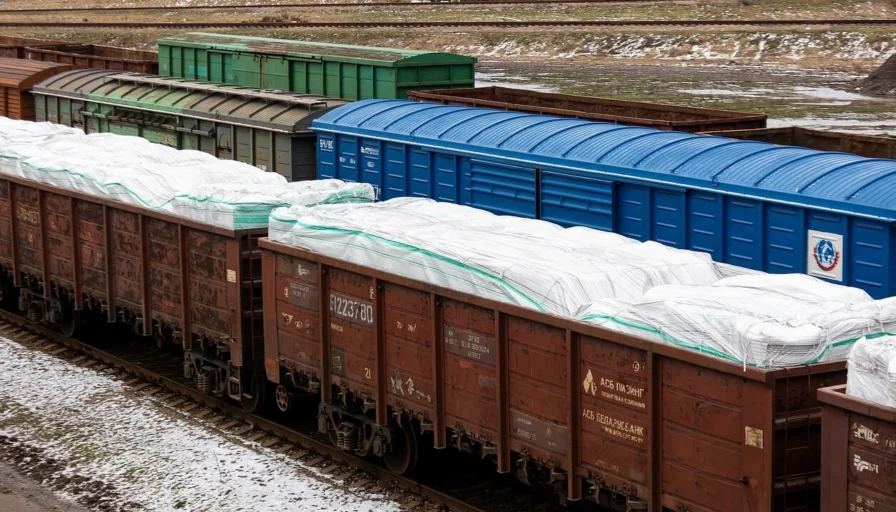
In early 2022 Lithuania banned the transit of Belarusian cargo as part of EU sanctions, and fertilisers were effectively cut off from the ports. From 1 February 2022 potash fertiliser transit was also halted. In January 2022 Lithuanian Railways rejected applications from three Belarusian companies to ship Belaruskali potash fertilisers to the port of Klaipėda.
The global price of potash fertilisers in October 2026 was 357.50 dollars per tonne, compared with 352.00 a year earlier.
Comments
To leave a comment, sign in with Telegram
Scan QR or open Telegram:
Open in TelegramWaiting for confirmation…