
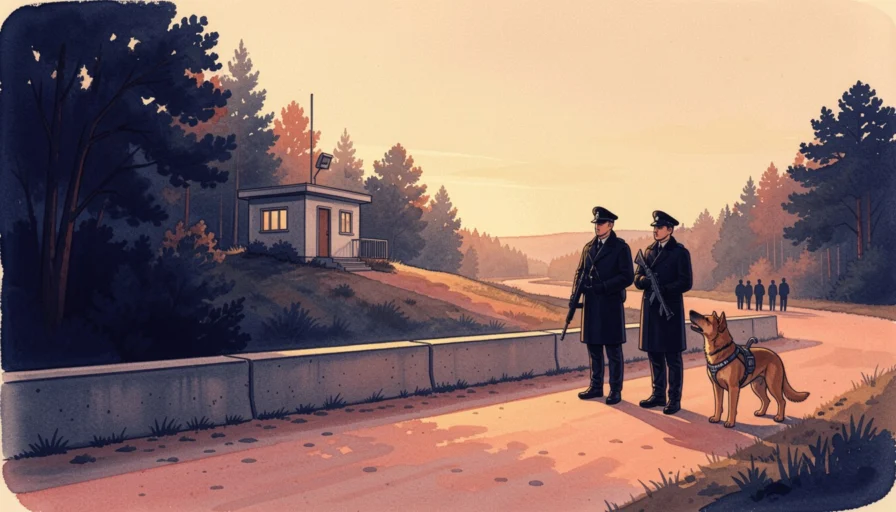
On 29 October, the Saeima of Latvia adopted amendments to the law on the State Border Guard. Under them, Latvian border guards guarding the state border will be able to use weapons not only in self-defence but also to repel an attack on a border service infrastructure facility, the Ukrainian outlet pravda.com.ua reports.
Before the vote, as reported, the Saeima's relevant committee supported the expansion of powers. According to this information, border guards will be able to use firearms, physical force, special equipment, explosives and service dogs to protect guarded facilities and border infrastructure.
According to the amendments, to repel an attack on a facility guarded by the border service, or on a state border infrastructure facility, border guards will be able to use physical force, special combat techniques, special equipment, weapons and a service dog.
Weapons may be used without warning if a warning is impossible in the specific situation. Raimonds Bergmanis, chairman of the defence committee, said the amendments expand border guards' ability to stop violations immediately.
If a person is wounded or killed when weapons are used, the border guard must report it to the prosecutor's office immediately, and no later than 24 hours afterwards.
Previously, such measures were permitted only in limited cases, for example when repelling an attack.
On the night of 5 to 6 October, according to pravda.com.ua, masked people tried to move 20 illegal migrants into Latvia. Those accompanying them threatened the servicemen who did not let the group through. A few hours later, masked people entered Latvian territory and damaged infrastructure.
A little-known group, "Black Rusy", claimed responsibility for the incident. Ukrainian Foreign Minister Andrii Sybiha said Moscow was behind it. Alyaksandr Lukashenka, by contrast, accused the Latvian side of staging the incident in order to get money from the EU.
In August 2023, Latvia, following Poland, built up forces on the border with Belarus: from 15 August the border guard carried out an additional mobilisation of border guards and asked the armed forces and the national police for help.
In addition, Latvia plans to extend for a year the ban on irregular bus services to Russia and Belarus. The restrictions will be in force from 1 November 2026 to 31 October 2027.
Comments
To leave a comment, sign in with Telegram
Scan QR or open Telegram:
Open in TelegramWaiting for confirmation…