
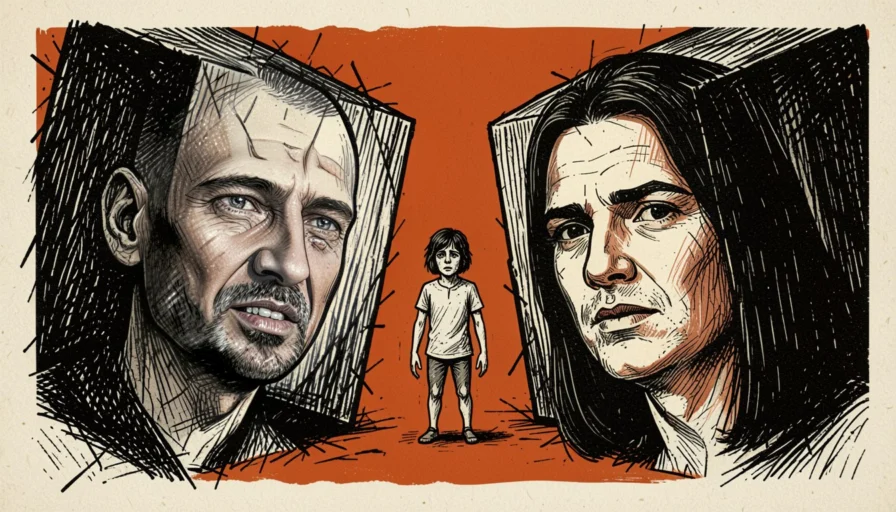
In a column for DW Belarus, businessman Vadzim Prakopyeu wrote that he thinks Sviatlana Tsikhanouskaya should listen to her husband's proposals. In his assessment, the struggle inside the democratic forces is no longer so much a struggle for Belarus's future as a struggle for the organisation's survival. Prakopyeu claims that Tsikhanouskaya's Office "is afraid of competition" and "has never known how to play fair."[1]
The occasion was Siarhei Tsikhanouski's streams. About 14 months after his release, he returned to what he did before his detention and runs exposé streams on the YouTube channel "A Country for Life" (on Belarus's list of extremist materials). He now criticises not only the Belarusian authorities but also his wife's Office, some Belarusian media in exile and analysts. The latest stream came out six days ago, and the video has gathered more than 14000 views.[2]
In that three-and-a-half-hour stream, Tsikhanouski said that his wife currently has "a certain legitimacy from the EU," but "no legitimacy from Belarusians as such at all" (the words are given in Russian in the original). He also said that Belarusians in Belarus "live quietly, keep silent," and that many have already regretted voting for the united candidate.[2]
Of Belarusians abroad, he said that most have become apolitical, have settled in, obtained documents and residence permits, and are working and paying off loans.[2]
In another stream, Tsikhanouski criticised his wife's conduct in August 2020. In his view, had she stayed in Belarus then, even at the risk of ending up behind bars, the protest would have had better chances. The trigger was Sviatlana Tsikhanouskaya's video address to former political prisoners who had signed a letter to the European Union.
Relations with Siarhei Tsikhanouski
Prakopyeu said that until May 2026 he was a "voluntary assistant" to Siarhei Tsikhanouski in the USA, and that they are now, in his words, "simply associates." He devoted his column to the path Tsikhanouski chose after moving to the USA.[1]
Tsikhanouski's former press secretary Siarhei Bespalau says that Tsikhanouski has become close to Prakopyeu, a restaurateur and blogger living in the USA. According to Bespalau, in 2022–2025 Prakopyeu repeatedly criticised Sviatlana Tsikhanouskaya's Office for "helplessness," "passivity" and opacity.
Conflict with the Office
Of Tsikhanouski's recent streams, Prakopyeu writes: "not a diplomat, to put it mildly," but he did not expect anything else. What he says he could predict, however, was how the Office would treat Tsikhanouski after his release, and so he suggested that Tsikhanouski move and work for Belarusian interests in the USA. Prakopyeu continues to maintain that the fate of a free Belarus will be decided first in Washington and only then in Minsk.
He calls his calculation risky but logical: America, he says, loves fighters for freedom, and the charismatic Tsikhanouski had a non-zero chance of becoming a recognisable figure in Washington. According to Prakopyeu, after the move Tsikhanouski, though late, got off to a decent start, and the two worked "like a racing driver and a navigator." He lists speeches at the European Parliament, Congress and universities, a column in The Washington Post, and meetings with John Cole and Christopher Smith. All of this, he writes, was only a warm-up, and the task turned out to be, perhaps, too ambitious for a man after five years in isolation.
Prakopyeu writes that in his recent streams Tsikhanouski sharply took on the journalistic standards of opposition media and the structure of the Office, and proposed rebooting the democratic forces. To questions about strategy, personnel and transparency, in his opinion, media respond with attempts to devalue the critic: the tone of headlines, play with context, artificial creation of news hooks and deliberate silence. Tsikhanouski, he believes, is being methodically branded as someone wounded by prison, an unbalanced abuser and "Lukashenka 2.0."
Prakopyeu asks why the Office should fight a man on whose political capital it arose, and why it cannot come to terms with him and integrate him, with all his talents and flaws. He himself calls the question naive.
Bespalau paints a different picture. In his words, it was impossible to work with Tsikhanouski because of his rudeness and "boorish behaviour." He claims that Tsikhanouski demanded that a journalist publish, under his own name, a text sharply criticising Office staff members Franak Viachorka and Dzianis Kuchynski. The text, according to Bespalau, began: "I can't watch Siarhei being made the culprit again and false information being spread…" Tsikhanouski's manners, in his assessment, turn him into a "boor." Tsikhanouski, as is known, is dissatisfied with the staff of the Office headed by his wife.
Sviatlana Tsikhanouskaya responded to her husband's criticism this way: he was not given recognition to sit in the Office and tell people how things should be done, and he "had that kind of trauma." She asked why "from a fighter against the regime he became a propagandist," and mentioned an author's programme on a state TV channel where, in a tuxedo and to music from "James Bond," he "reveals the secrets of fugitives." She herself, in her words, has "thank God, not seen it."
Criticism of media in exile
Prakopyeu writes that the problem of "partisan" media is not unique: the USA also has politically engaged media, but there one can choose between CNN and Fox News, The New York Times and the New York Post. Belarusians, he says, have things "homespun, village-style," and, with rare exceptions, one continuous "telethon."
He does not think Franak Viachorka phones editors on a "government hotline": there is no need, everyone understands everything, and the reflex was developed back in the days of one of the earlier projects. Prakopyeu names as the main defect the dependence of leading media in exile not on subscribers but on donors, who fund both editorial offices and political structures. The Office, he says, naively takes pride in helping newsrooms obtain grants, as though there were no conflict of interest, and objectivity becomes a victim of "grant solidarity." The situation, he adds, is sometimes saved by individual journalists.
The Office's finances
Questions about the Office's transparency have been raised before. On 19 September 2023, according to the Office's press service, it received a report from the audit company MOORE Mackonis. The Office commissioned the audit in response to a public request. The auditors examined documents and reports from the start of registration until 31 December 2022 and, as the report states, found no violations or misstatements.
According to the report, the Office's income for the year was 176000 euros, of which 5600 euros was revenue from sales and the rest was funding. Expenses were 182000 euros, almost all of which went on operating needs: salaries, rent and so on. The report also says that money for democratic transformation is often allocated by international organisations, and that the Office does not manage it or decide to whom it is directed.
The Office itself says that together with partners it held a number of information and political campaigns and conferences, and organised Sviatlana Tsikhanouskaya's visits to dozens of countries and hundreds of meetings and calls with partners and Belarusians inside the country.
Context and biography
Prakopyeu not only defends Tsikhanouski but also criticises him. In his words, Siarhei is "not a diplomat," and with schoolyard name-calling and personal attacks he helps opponents marginalise him. At the same time, he writes that the Office "stands on his political shoulders."[1]
Prakopyeu believes that after moving to the USA, Tsikhanouski had to move to a different level of English, study American politics and polish his manners by enrolling in a good university. Tsikhanouski chose a different path and returned to his comfort zone. Prakopyeu calls this a low bar, but says he respects the choice: a blogger it is, as long as it serves the cause.[1]
Prakopyeu himself left Belarus after the 2020 presidential election, and in December 2023 moved to the USA. Two months earlier, in October 2023, the Investigative Committee opened special proceedings against him.
Comments
To leave a comment, sign in with Telegram
Scan QR or open Telegram:
Open in TelegramWaiting for confirmation…