
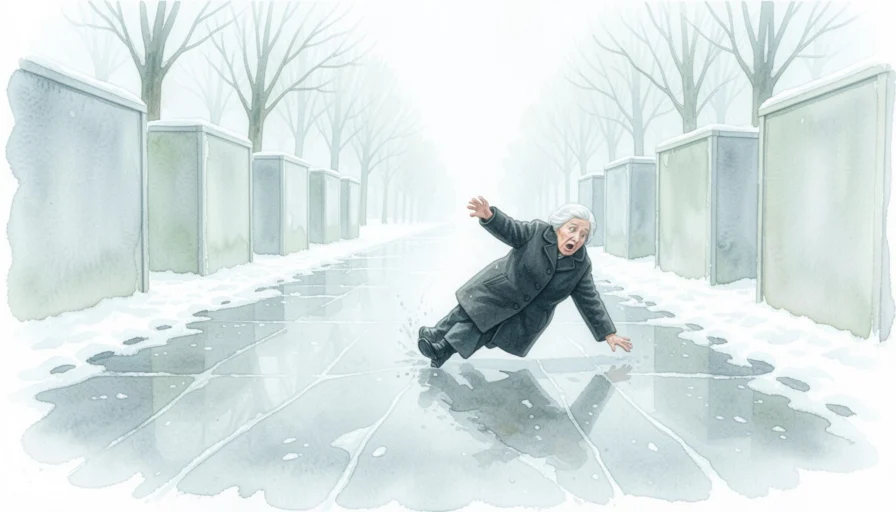
According to the press service of the Belarusian Ministry of Health, the first ice and cold injuries in the country began to be registered on 21 November 2024. The number of injured people at that point was 546, with the most cases recorded in the Homel region.
In the Brest region, according to the ministry, 67 injured people have been registered: 9 patients were hospitalised, the rest received outpatient care. Ice injuries were sustained by 62 patients, cold injuries by 5.
For a long time it was believed that a skate glides because the ice under it melts. According to a Nature reference article, skaters glide on a layer of rotating molecules, not on ice melted under the blade. Ice is slippery because the molecules in its surface layer are only weakly bound to one another.[1]
A scientific paper describes the ice surface as a thin layer of molecules that in a number of natural conditions behaves like a liquid. It is now generally accepted that melting under pressure plays a small role in the low friction of ice, except at temperatures near the melting point.[2]
Laboratory studies examined how age-related changes in gait affect the onset of slipping and the frequency of falls. In one of them, 28 participants from two age groups, young and older, walked around a circular track wearing a safety harness. At random moments, without their knowledge, a slippery surface was placed on the track over a force plate.[3]
The horizontal velocity of heel contact with the surface turned out to be significantly higher in older participants, their stride was shorter, and the acceleration of the body's centre of mass during weight transfer was significantly lower. Older participants slipped for longer and faster and fell more often. Among those who fell, heel contact velocity was generally higher than among those who did not. The authors conclude that it is precisely these age-related changes in gait that affect the onset of a fall when slipping.[3]
Another laboratory study looked at how unintentional slips occur, are detected and are overcome. It involved 42 people — young, middle-aged and older — who also walked on a circular track. Young people slipped as often as older people, meaning the likelihood of the slip itself is similar across all age groups. The difference was in recovery: in older people it was much slower and less effective.[4]
The ability to recover from a slip and not fall is believed to depend on leg muscle strength and on the deterioration of sensation in older people.[4]
A one-year double-blind randomised study was carried out in Perth, Australia. It involved 302 older women aged 70 to 90 with low blood levels of vitamin D and falls in the previous year. Among those who received ergocalciferol, at least one fall during the year occurred in 53.0%, in the control group in 62.9%.[5]
The authors conclude that for patients with prior falls and a vitamin D deficiency in a sunny climate, an ergocalciferol supplement together with calcium is beneficial: it is associated with a 19% reduction in the relative risk of falling, mainly in winter.[5]
Data from Taiwan show the scale of the consequences. Falls account for 3.29% of all hospitalisations of older people, while older people account for 47.5% of all hospitalisations due to falls. Most hospitalised older people (61.8%) were treated in orthopaedic departments, and 64.6% of them were diagnosed with fractures.[6]
The length of hospital stay ranged from 1 to 110 days, averaging 8.67 days. The average cost of treatment was 56355.11 new Taiwan dollars (1761 US dollars) per person. There were more hospitalisations due to falls in winter than in other seasons.[6]
According to the US National Institute on Aging, older people are more vulnerable to the effects of cold weather. Its dangers include falls on snowy and icy surfaces, frostbite and hypothermia — a condition in which body temperature drops too low and emergency help is needed.[7]
Comments
To leave a comment, sign in with Telegram
Scan QR or open Telegram:
Open in TelegramWaiting for confirmation…