
From 1 December 2026, the building norms for planning and developing settlements change in Belarus (SN 3.01.03-2020, Amendment No. 4). They are set out in Resolution No. 70 of the Ministry of Architecture and Construction dated 25 August 2026. The main point for plot owners: it will no longer be possible to agree a smaller distance to the boundary with a neighbour.
The deputy chairman of the committee and head of the architecture and territorial development department, Mikalai Vlasiuk, commented on the new requirements. Experts cited by Belarusian state media believe the updated norms will make the building rules clearer, reduce the number of disputes between neighbours and make the living environment safer. This is the assessment of the norms' authors and supporters, not the result of something that has already happened. The rules apply specifically to new construction.
Below is what changes, starting with what will affect the most people.
First, a neighbour's notarised consent. Previously, with the consent of the adjacent land user, it was possible to build closer than the established distances; this required notarised consent. From 1 December, as the architecture and construction department of the Minsk District Executive Committee reported, such consent will no longer be grounds for departing from the standard distances. The option of a smaller distance by a neighbour's consent is completely removed.
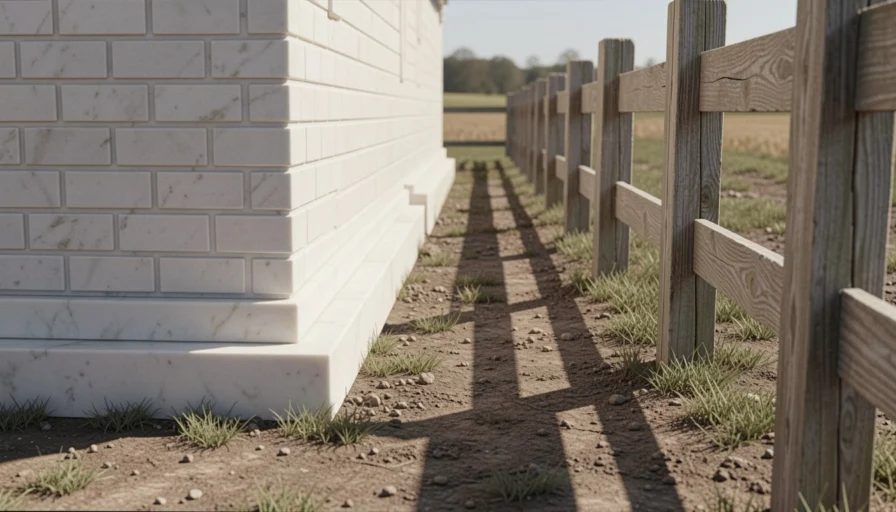
Second, the distances themselves. For new construction, a residential house must stand no closer than 3 metres from the neighbour's boundary, and outbuildings (a garage, a shed, a bathhouse) no closer than 2 metres. The difference between them is 1 metre, meaning the requirement for a house is 50% stricter.
Third, what to measure from. The distance to the boundary is measured strictly from the plinth or the outer walls, not from roof overhangs, eaves or canopies.
Realtor Yauhen Khlopetski said on his TikTok channel that one should go by the real boundary of the plot, not by the fence. According to him, a house may visually stand three metres away and still be built wrongly. He advises that, if in doubt, you call in surveyors and have the boundary determined.
Fourth, what has already been built. Owners of old buildings will not be forced to demolish them: they can be repaired and reconstructed, but without enlarging their dimensions towards the neighbour's boundary. The rules do not apply to those who already have such setbacks and neighbours' consents; they apply to those who start new construction from 1 December 2026. How the distances will be checked when a building is put into operation is not yet clear.
Fifth, charging stations. In new residential neighbourhoods and near public buildings, at least 10% of parking spaces must be equipped with charging stations.
Sixth, waste sites. Waste container areas are banned from being placed closer than 20 metres to the windows of residential buildings, playgrounds, schools, kindergartens, shops and cafés.
Seventh, access roads and safety. Building roads for cars across pedestrian paths leading to children's and sports playgrounds is explicitly prohibited. The service area of a fire station without high-rise rescue equipment is limited to 2.4 km, and the gaps to forest are kept: at least 50 m to a coniferous stand and at least 20 m to a deciduous one.
Comments
To leave a comment, sign in with Telegram
Scan QR or open Telegram:
Open in TelegramWaiting for confirmation…