
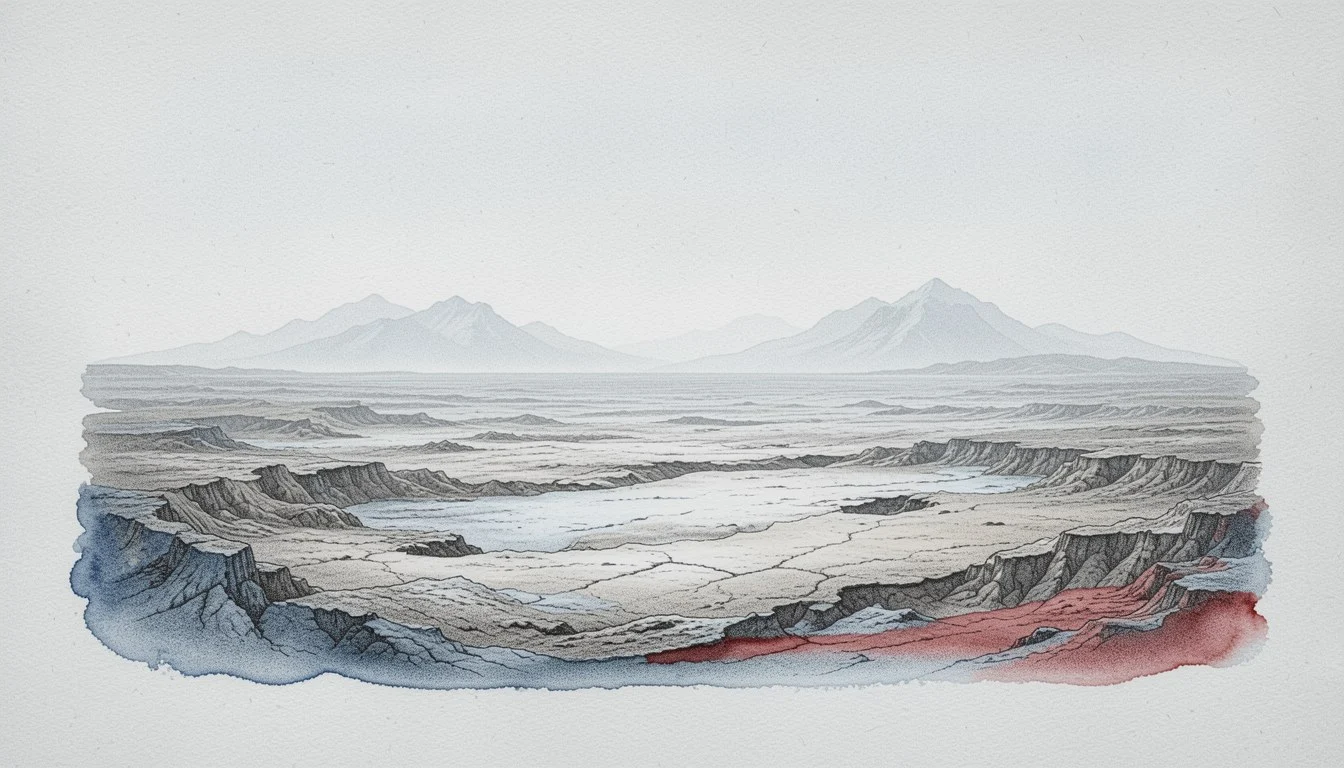
Chinese researchers have discovered a previously unknown cycle linked to Earth's movement around the Sun. Ancient rocks preserve evidence that extremely powerful storms arose on the planet roughly every 405000 years.
The scientists studied tempestites in the Sichuan Basin in China. These are rocks about 500 million years old, from the Cambrian period: they formed on the floor of a long-vanished sea. In the sedimentary rocks they found repeating structures and reconstructed a geological history spanning about 24 million years. The study identified 59 cycles, each lasting about 405000 years.
Tempestites most often appeared during the build-up and peak stages of each cycle. During these periods thicker layers of sedimentary rock formed, which points to increased storm intensity. The results were published in the journal Palaeogeography, Palaeoclimatology, Palaeoecology.
The appearance of such storms may be linked to periodic changes in Earth's orbit caused by the gravitational influence of other planets in the Solar System. There is also an orbital cycle lasting about 400000 years, the Milankovitch cycle: the orbit changes mainly because of the influence of Venus and Jupiter. The scientists suggest that in the warm Cambrian climate such fluctuations could periodically have intensified ocean heating and created conditions for more powerful storms. The researchers say this relationship has not yet been conclusively proven.
Whether similar storms could arise today remains unclear: the modern climate differs from the Cambrian one and may lack the conditions for very powerful storms with the same periodicity.
Comments
To leave a comment, sign in with Telegram
Scan QR or open Telegram:
Open in TelegramWaiting for confirmation…