
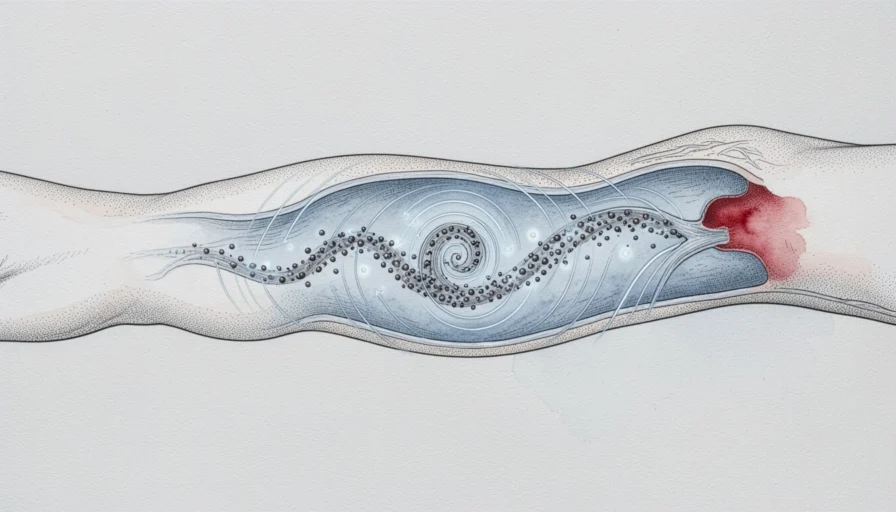
Researchers at ETH Zurich have developed microrobots made of a biocompatible gel with magnetic nanoparticles, which are injected into blood vessels. Under an external magnetic field, they help a drug dissolve blood clots faster. The university announced the study on 9 November.[1][2]
In a laboratory model of a vessel with clots made of pig blood, the drug together with the robots dissolved the clot six times faster than without them. In live pigs, after 30 minutes the area of restored blood flow was twice as large as with the drug alone. According to other accounts of the same tests, clots dissolved about 10 times faster.[1][2][3]
Simone Schürle, professor of medical microsystems at ETH Zurich, said that, to the team's knowledge, she was the first to show on a clinically relevant large-animal model that this approach genuinely enhances thrombolysis, that is, the dissolving of blood clots.[4]
Each robot is bullet-shaped: a rigid frame with iron oxide nanoparticles is coated with a hydrogel shell. According to Schürle, a robot is about eight microns long, less than a hundredth of a millimetre, and similar in size to a red blood cell.[1]
A rotating magnetic field generated outside the body makes the robots tumble along the vessel wall. This creates flows that push the clot-dissolving drug straight toward the clot. The robots are injected by catheter next to the clot, together with the drug.[3]
The researchers borrowed the idea from bacteria that orient themselves by the Earth's magnetic field using tiny magnetic structures. Schürle said the team was struck by the physics and properties of these bacteria in rotating magnetic fields.[2]
Clots were placed in the kidney vessels of live pigs, and the robots were injected together with the drug. The work was carried out jointly with Berlin's Charité clinic. Blood flow was restored over a larger area than with the drug alone.[5]
A preprint of the work was published on Research Square on 9 March 2026. It describes a similar system with robots about 10 microns in size, made of a dextran shell and chains of iron oxide nanoparticles. The combination gave better recanalisation at drug doses far below clinical ones. There is no peer-reviewed publication yet.[2][6]
The technology has not been tested on humans. Before clinical use, longer safety trials on animals are needed, as well as testing on models of specific diseases, including myocardial infarction. The team plans tests on larger animals and over a longer period. Earlier, in mice, the iron oxide and the hydrogel shell broke down safely in the body within several weeks.[5]
The university has filed a patent application. The project's authors Nicola Cesarovic, Joshua Mefin, Simone Schürle and Imo Jan were among five finalists for the 2026 Spark Award.[4][7]
Blood clots block blood flow and interfere with the supply of oxygen to tissues, which can lead to a heart attack or stroke. Drugs that dissolve clots exist, but delivering them to the blockage is hard precisely because the blood flow is disrupted.
Comments
To leave a comment, sign in with Telegram
Scan QR or open Telegram:
Open in TelegramWaiting for confirmation…