
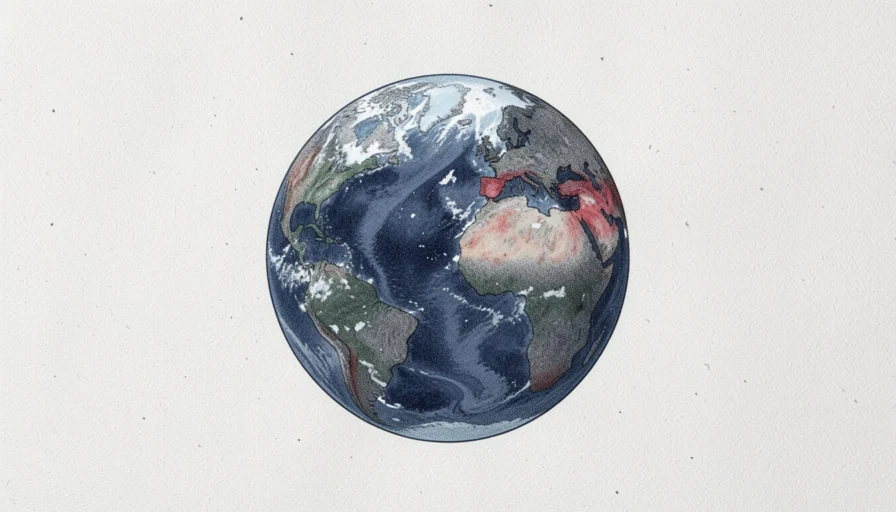
An international team of scientists has modelled what Earth would look like if life had never appeared on it, and concluded that the planet could have remained habitable for more than 4.5 billion years. The study was carried out by a group led by astrobiologist Samantha Gilbert-Janizek of the University of Washington. As ScienceAlert reports, it has been published in The Planetary Science Journal.
The scientists built a model of Earth without a biosphere but with its other physical components: core, mantle, crust, atmosphere, oceans and the flow of solar radiation. They modelled 19 key characteristics of the planet, among them heat flow, the chemical composition of the oceans and surface temperature.
The virtual Earth was followed over five billion years: from the formation of the planet to a point roughly 500 million years in the future.
The absence of life did not significantly affect the planet's surface, with one exception: there is no oxygen in the atmosphere, because there is no photosynthesis. The water level in the model was comparable to the present one.
The researchers wrote: "We show that on an Earth-like planet, habitable surface temperatures can be maintained over 4.5 billion years of evolution (and more) solely through abiotic processes, without any biological mechanisms of climate regulation. The carbonate-silicate cycle, driven by the interaction of silicate weathering, volcanic degassing and chemical processes in the ocean, creates a stable negative feedback. It keeps the concentration of atmospheric CO2 and the surface temperature within limits suitable for life, even though over 4.5 billion years the Sun's luminosity has increased by about 30%."
The results indicate that the presence of life is not necessary for a rocky planet to remain habitable.
According to the Gaia hypothesis, life interacts with the planet's physical environment in a way that helps maintain conditions suitable for life. In Science Alert's assessment, the simulation offers a new perspective on the ideas underlying this hypothesis.
The authors themselves name as the central question of the work whether life is necessary for the long-term habitability of a rocky planet. The scientists acknowledge that the model has limitations and simplifications, including assumptions about plate tectonics, atmospheric chemistry and the processes that regulate Earth's climate.
Comments
To leave a comment, sign in with Telegram
Scan QR or open Telegram:
Open in TelegramWaiting for confirmation…